Suppression of Transition Metal Dissolution... by David A. Boyd et al 2024
Download PaperOvercoming Transition Metal Dissolution
Next Generation Cathode Active Materials (NG-CAM), such as Li, Mn-Rich (LMR) oxides, offer extremely high intrinsic specific capacities, potentially exceeding 1000 Wh/kg. Despite this potential, these materials historically suffer from rapid capacity fade and short cycle life due to Transition Metal Dissolution (TMD). Current solutions designed to suppress TMD, such as various oxide or fluoride coatings, often possess marginal electronic and ionic conductivity, which limits critical fast-charging capabilities. Our Graphene enhanced Nanoparticles (GEN) technology provides a proven, practical, and scalable approach to enable the mass adoption of these high-capacity chemistries.
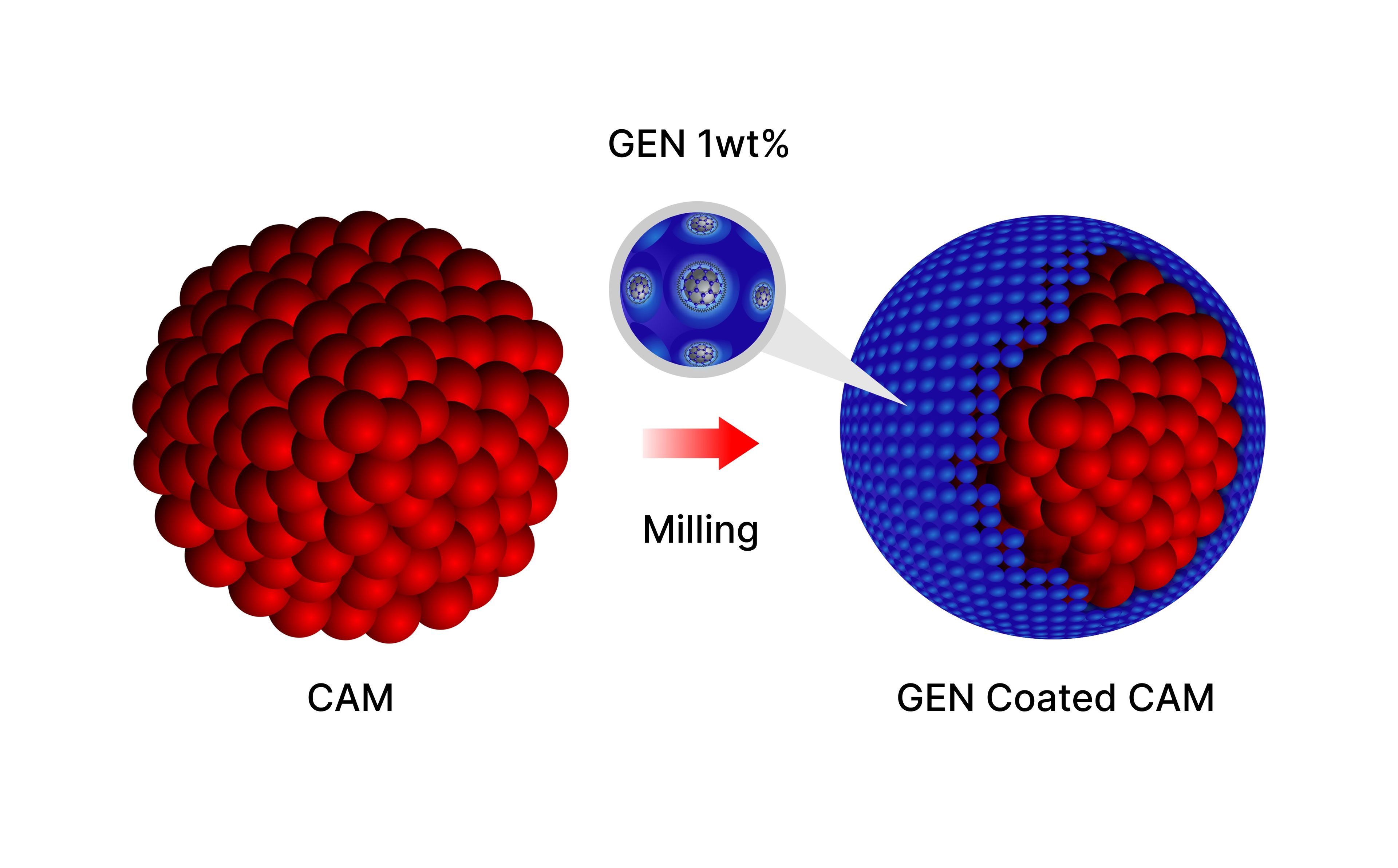
GEN with Advanced Cathode Materials
GEN stands for Graphene Encapsulated Nanomaterial, a breakthrough component that is dry-mixed with the cathode material. These are oxide-graphene nanocomposite particles created using a patented low-temperature Microwave Plasma-Enhanced CVD (PE-CVD) process. The functionalized graphene layer, which can be customized during production, disrupts the cascade of side-reactions that lead to TMD and subsequent failure. GEN provides a targeted delivery mechanism for functionalized graphene, which suppresses TMD while improving rate capabilities
High-rate charging and long cycle life
The addition of just 1 wt.% GEN significantly suppresses TMD in Cathode Active Materials. In LNMC cells tested under stressful, high voltage, and high-temperature conditions, this suppression nearly doubles the overall cycle life. Furthermore, the incorporation of GEN offers dramatically improved rate capabilities relative to uncoated CAM.
GEN technology has demonstrated improvements in rate capability relative to uncoated CAM of over 40% at 5C at 25 °C and over 50% at 2.5 C at 60 °C.
This unique technology is poised to enable Next Generation CAM to exceed critical industry benchmarks, including the USABC goals for fast high-rate charging and cycle life greater than 1000 cycles.
Scalable and Cost-Effective Integration
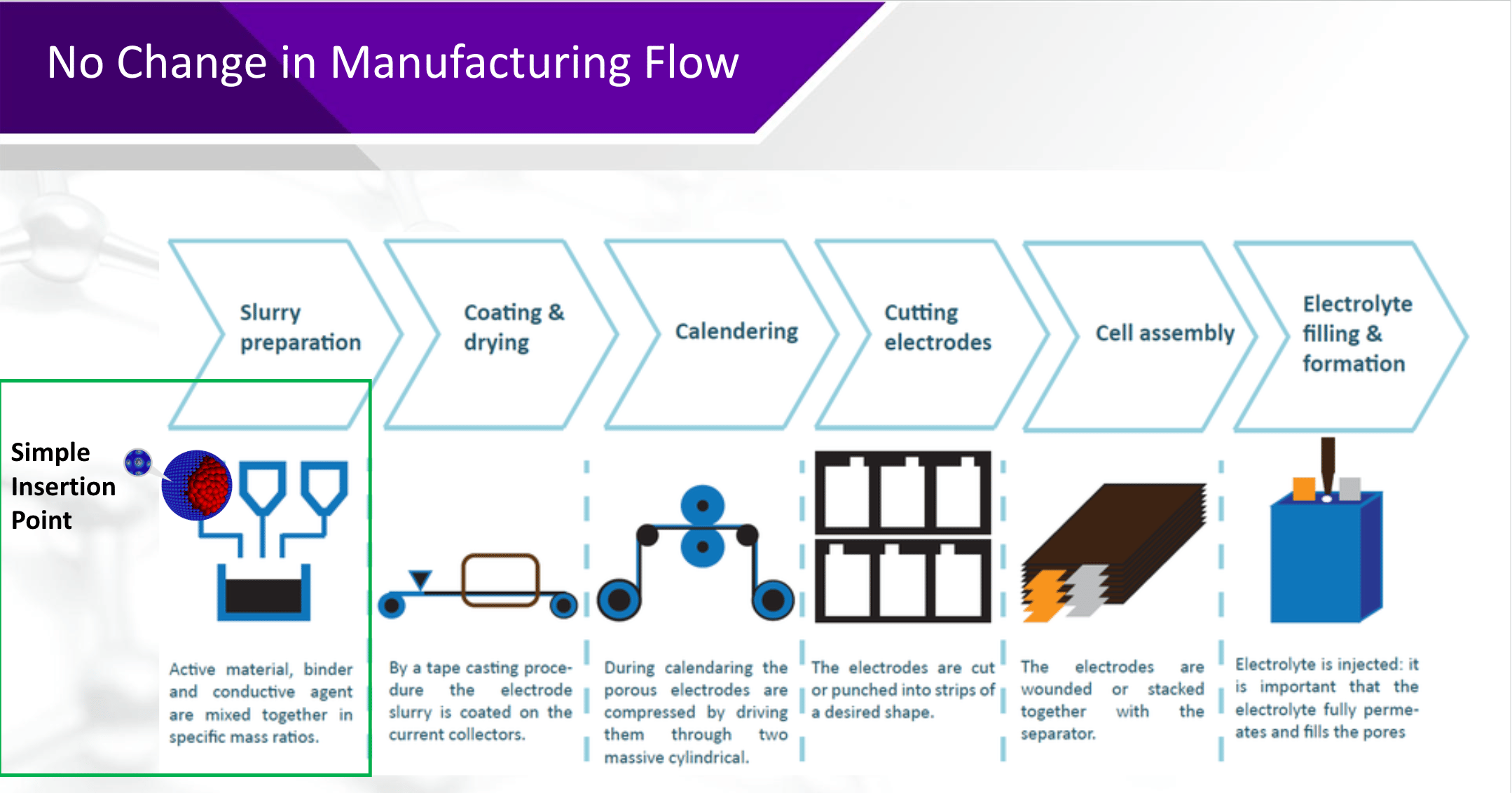
GENOA is applied to CAM using Ordered Mixing, a scalable, low-energy, top-down dry-mixing process that easily integrates into existing battery manufacturing workflows. This method is highly desirable as it avoids the long process times, high energy usage, and structural damage associated with bottom-up coating techniques like thermal CVD or ball milling. Graphene Enhanced Nanoparticles (GEN) is an economically viable and disruptive platform technology.
How can we help you innovate?
Get in touch to discover more and to take part in the evolution of energy storage.